巴西大奖赛排位赛遭遇雨天挑战
巴西大奖赛排位赛因雨延误,一度看起来无法继续进行。
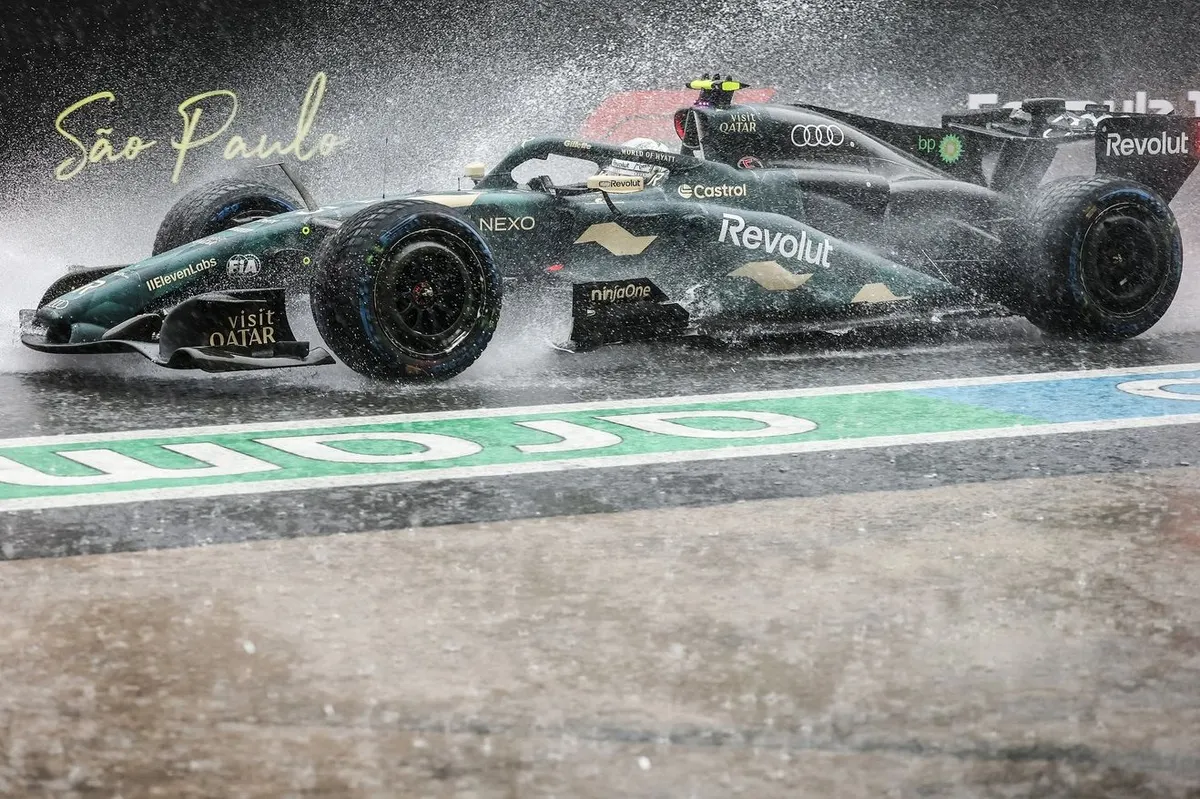
巴西大奖赛排位赛的雨天挑战
圣保罗的天气一开始温暖,但很快因为降雨而变得几乎无法进行,让车手们面临了他们职业生涯中最湿滑的赛道条件之一
一小时二十三分钟。你几乎可以把一场足球比赛的大部分时间都压缩在圣保罗大奖赛F1排位赛的雨中延误里,而且看起来这个环节实际上不会再开始了
2024年的情况似乎会重演,当时排位赛被压缩到了周日早上,但就在这时,一个救星出现了,云层出现了一丝缝隙,赛道干燥到足够安全车专家Bernd Maylander批准赛道的条件。这几乎无法阻止一些车手抱怨能见度,但他们很快接受了他们需要锁定并专注于绕赛道行驶
这意味着使用较少见的全湿胎,或者按照F1术语的"x-wet"。这种轮胎常常被嘲笑为只适合在安全车后面笨拙地行驶,但实际上这种蓝色侧壁的Pirelli轮胎表现相当不错,并且证明非常适合赛道周围的水位。尽管如此,由于轮胎难以打破赛道上的水膜,水漂现象仍然普遍——但随着雨势减弱,水分的分散很快使赛道恢复到可驾驶的状态。
使用极端湿胎的缺点在于水分分散得更快(据Pirelli称,每秒约85升水),这极大地降低了能见度,因为车后喷出的水花像公鸡尾巴一样。然而,水分分散是必要的恶行:没有它,赛道会保持更长时间的水湿状态。
尽管雨灯确保了后面的车手至少有一定程度的能见度,但选择刹车区域仍然很棘手;能见度低意味着车手必须在他们的视野范围内找到一个参考点。停车距离也相应地更长,因此车手需要不同于干燥路面上的刹车踏板应用点。
考虑到所有这些气候挑战,难怪赛车控制对湿滑条件采取更为谨慎的态度。因此,看到赛会重新开放练习是个令人惊喜的消息——即使赛道仍然因为下午的暴雨而泥泞不堪。卡洛斯·塞恩斯认为这是FIA的一个"大胆"决定——但只用了几圈就确保了车辆更加稳定。
“当我们从x-wet轮胎起步时,感觉有点打滑,因为我们在直线道上第六和第七挡时都在水漂。如果你在那个速度下失去对车辆的控制,那肯定是一次很大的失误,”赛恩斯在赛后总结道。
“此外,当你紧贴着其他车辆行驶时,能见度非常低,但在排位赛中我们没有被迫紧贴其他车辆,所以可以留出一定的空间来观察。但两圈下来,情况非常不稳定。”
“然后我们设法找到了那一点干燥的路面,轮胎开始正常工作,水漂现象也开始消失。每个人都设法将车辆保持在赛道上直到Q1结束,这实际上有点令人惊讶。”
“利亚姆·劳森同意赛恩斯的看法,他表示,“当我们开始比赛时,情况非常不稳定——我认为我们确实是在冒险。但我喜欢我们出现在赛道上而不是在维修区;显然这是有风险的,但事故并不多。”
正如预期的那样,湿滑的天气条件给了那些通常不习惯在顶级位置战斗的赛车机会;自由练习中的性能追逐实际上变得无关紧要,动力单元之间的差距略微缩小,因为顶级性能和加速的效果被低抓地力的赛道条件所减弱。
这使低速下压力变得更加重要,更重要的是,在Q1期间保持轮胎温暖——尽管费尔南多·阿隆索还是指出,“发动机在驾驶性和它在弯道中的表现方面非常重要,我们在这方面仍然有一些问题。”
通过Q1的策略最初只是尝试跑出干净的圈速,并希望赛道的进展和轮胎的进步能够带来圈速的逐圈提升。
当然,每位车手都在发生水漂时测试了他们的反应时间,2026年的动力单元和对后刹车的控制增加了另一个需要克服的障碍。但每位车手(在很大程度上)都越来越专注于调整,看着圈速提高,然后随着赛道变干,开始稍微加大刹车区域的压力。
Q2阶段有一个转折点,因为中雨胎很快成为了最佳选择。由于积水减少,全雨胎开始过热,并且在赛道中段损失性能,最初足以抵消第一和最后两个赛段的潮湿,但在三个赛段都更适合使用中雨胎之前,这种情况就已经发生了。
这意味着他们可以更多地追求赛道抓地力,并且很明显,在Q2结束时,随着赛道在暴雨中达到最佳状态,时间开始达到峰值。劳森认为他和他的小红牛车队已经完美掌握了中雨胎的时机,这是在不冒掉出赛道风险的情况下获得更快圈速的关键。
一些车手在这个转换点上遇到了困难,尤其是在12号弯的收获和刹车时——塞恩斯和Ollie 贝尔曼都在这里出了事故,而新来的Rafael Camara在Q2结束时无法让车足够慢下来,撞上了护栏。
在Q3期间预计会有更多雨,所以更多的是一场疯狂的冲刺,以完成一个干净的圈速,而不是观察进展。这可能就是感觉最像'正常'的排位赛的时候,因为轮胎实际上足够支持一整圈的预期暴雨设置了一个计时器。
大多数车手真正地享受了这种罕见的机会,去应对真正的湿滑赛道,尽管有些人对恢复练习有所顾虑。乔治·拉塞尔推测说:“我喜欢在雨中驾驶——但如果是比赛,我们不应该那样驾驶——发生真正可怕事故的可能性非常高。”
年轻车手和年长车手之间可能存在一些意见分歧;刘易斯·汉密尔顿和尼科·胡肯伯格都表达了对湿滑赛道的喜爱,而新冠军基米·安东内利则称这是“我开过最湿滑的条件”;他和贝尔曼都说在Q1恢复时赛道已经超出了极限,尽管后者承认早期的练习至少有助于赛道改善。
无论如何,这对每位车手在周日比赛前的数据都是宝贵的——届时恶劣天气预计将再次发挥作用。因此,夜间讨论开始了:是否有人为了设置改变而冒险从维修区起步?
观看:基米:改变一切的两年
英文原文
The wet-weather challenges thrown up by Brazilian GP qualifying
A warm start to the day in Sao Paulo quickly descended into a near-washout as the rain fell - and left drivers facing some of the wettest conditions they've driven in across their racing careers
One hour, 23 minutes. You could've squeezed most of a football match into the rain delay during Formula 1 qualifying for the Sao Paulo Grand Prix, and it looked for all the world like the session wouldn't actually get going again.
A repeat of 2024, where qualifying was squeezed onto Sunday morning, looked likely. Yet, a saviour arrived when a break in the clouds emerged, and the circuit had dried just enough for safety car specialist Bernd Maylander to give his approval of the conditions. It scarcely stopped a handful of drivers from having a moan about the visibility, but they soon accepted that they needed to lock in and focus up on getting around the track.
This meant the use of the lesser-spotted full-wet tyre, or the "x-wet" per the F1 lexicon. Often derided as a tyre only fit for bumbling around on behind the safety car, the blue-walled Pirelli was actually holding up pretty well and proved perfect for the level of standing water around the circuit. Aquaplaning, where the tyre struggles to break the surface tension of the water on-track, was nonetheless prevalent - but water dispersal as the rain held off soon brought the track to a more driveable state.
The downside of using the extreme wet tyre lies in the greater water dispersal (according to Pirelli, around 85 litres of water per second) which drastically cuts visibility as the spray rooster-tails out the back of the car. Yet, the dispersal is a necessary evil: without it, the circuit would just remain wetter for longer.
Although the rain lights ensure that the driver behind has at least some level of visibility, selecting your braking zone remains tricky; poor visibility means the driver must find a reference point in their immediate circle of vision. Stopping distances are also considerably longer, so a driver needs a different marker to their usual point of pedal application in the dry.
Considering all these climatic challenges, it's small wonder why race control takes a more tentative approach to wet conditions. Hence, it was a welcome surprise to see the session reopened - even if the circuit was still sodden with the afternoon downpour. Carlos Sainz reckoned that it was a "punchy" call from the FIA - but it only took a couple of laps to ensure the cars were more stable.
"It felt a bit punchy when we left on the x-wet because we were aquaplaning in sixth and seventh gear down the straights. And if you lose the car at those speeds, it's always going to be a big one," Sainz concluded after the session.
"Also, very little visibility when you were running close to a car, but we were not forced to run close to cars in quali, so you can create a bit of a buffer to see. But it was very sketchy for two laps.
"Then we managed to create that little bit of dry line and the tyres started working, the aquaplaning started to go away. Everyone managed to keep the car on track until the end of Q1, which was a bit of a surprise, to be honest."
Liam Lawson agreed with Sainz's view of the session, stating that "when we started, it was extremely sketchy - I think we were definitely pushing it. But I like the fact that we were out there and not in the garage; I think obviously it is risky, but there weren't that many incidents."
As expected, the wet conditions delivered chances to those usually not accustomed to fighting at the top; the free practice performance-chasing was effectively rendered obsolete and the power units had slightly more parity as the effects of top-end performance and acceleration were mitigated by the low-grip track conditions.
This put a bit more of a premium on low-speed downforce and, crucially, keeping the tyres warm across Q1 - although Fernando Alonso nonetheless noted that "the engine is very important in terms of drivability and the way it behaves in the corners, and we still have a little bit of an issue there".
The approach through Q1 was, initially, simply about trying to set clean laps and hope that the progression of the circuit and the tyres would yield a lap-on-lap improvement.
Of course, each driver was tested on their reaction times in the event aquaplaning occurred, and the 2026 power units and the control over the rear brakes added another hurdle to overcome. But each driver (largely) became increasingly dialled in, watched as the laptimes improved, and then started to push the braking zones a little bit more as the circuit dried up.
There was a transition point in Q2, however, as the intermediates soon became the tyre to be on. With less standing water, the full wet was starting to overheat and was giving up performance in the middle part of the lap, initially enough to perhaps offset the dampness through the first and final sectors, before all three became much more suitable for the intermediate overall.
This meant that they could chase the track grip more, and it was evident that the times had begun to peak at the end of Q2 as the circuit approached its best conditions under the downpour. Getting the intermediate timing right, which Lawson reckoned he and his Racing Bulls team had nailed, was key to getting a couple of quicker laps in without risking the threat of falling off the circuit.
A few drivers struggled at this crossover, particularly with harvesting and braking into Turn 12 - Sainz and Ollie Bearman both had offs here, as newcomer Rafael Camara couldn't get the car to slow down enough before he careened into the barrier at the close of Q2.
With more rain impending during Q3, it was more about a mad dash to get a clean lap in, rather than watching the progression. That's perhaps when it felt most like 'normal' qualifying, as the tyres were effectively good enough for one lap with the expected downpour setting something of a timer.
It appeared that the majority of the drivers genuinely enjoyed the rare chance to tackle properly wet conditions, although some had a few qualms about the session restarting. George Russell surmised that "I love driving in the rain - but at some point, if that was a race, that was no way we should be driving in it - the chances of seeing a really, really horrific incident is very, very high."
Perhaps there's a bit of a split of opinion between the younger and older drivers; both Lewis Hamilton and Nico Hulkenberg expressed their enjoyment of wet conditions, while new champion Kimi Antonelli labelled them "the wettest conditions I've ever driven [in]. So it was not the nicest of experiences"; both he and Bearman said that the circuit was over the limit at the Q1 restart, although the latter conceded that the early running did at least contribute to the circuit improving.
Regardless, it was valuable data for each of the drivers ahead of Sunday's race - where inclement weather is expected to play a role once again. And so begins the overnight discussions: does anyone risk a pit-lane start for a set-up change?
Watch: Kimi: Two Years that Changed Everything
Motorsport.com ·
内容来自公开信源,聚合内容版权归原作者与来源所有。