F1巴西大奖赛长距离测试:安东内利统治,法拉利遭遇噩梦周五
安东内利在圣保罗的F1周末表现出色,不仅在自由练习2中单圈最快,还在长距离测试中表现出色。相比之下,法拉利遭遇困难。
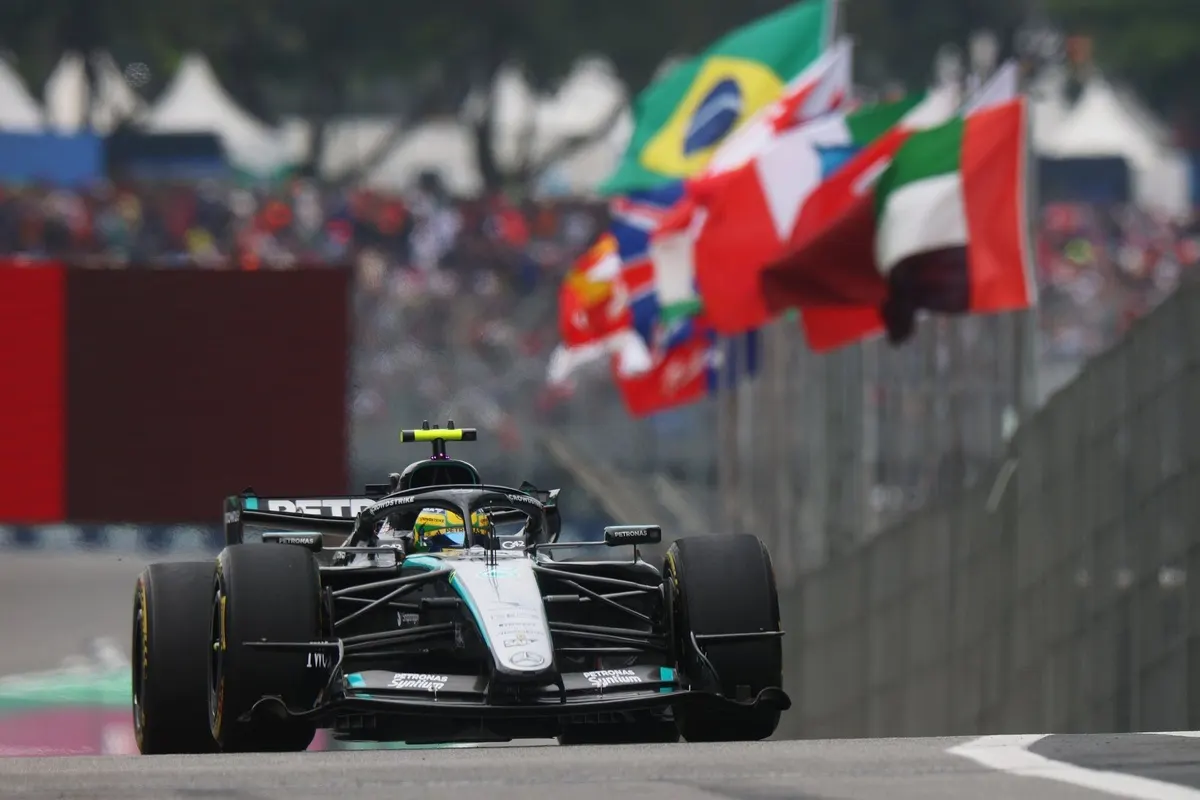
F1巴西大奖赛长距离测试:基米·安东内利统治,法拉利遭遇噩梦般的周五
这位新晋世界冠军在伊伯拉戈斯的资格赛和比赛模拟中均领先,而梅赛德斯车队脱颖而出,成为最具竞争力的车队,而法拉利在平衡性和轮胎磨损方面遇到了困难
基米·安东内利在迄今为止的圣保罗 Formula 1 周末比赛中一直是标杆。这位新晋世界冠军不仅在第二次自由练习中单圈速度最快,而且在长距离模拟中也做出了强有力的表态。因此,梅赛德斯车队似乎在周末剩余的时间里处于最有利的位置。相比之下,法拉利度过了一个极其艰难的周五
在资格赛模拟中,安东内利比麦卡伦车队的兰多·诺里斯快了0.253秒,比红牛车队的马克斯·维斯塔潘快了0.259秒。然而,在练习会话末尾的比赛模拟中,才提供了对周日前景更有意义的指示。
分析数据时需要考虑不同的赛段长度和轮胎配方。在巴西,轮胎磨损尤其严重,这意味着仅仅几圈的时间差就会对平均圈速产生明显的影响。一旦数据相应调整后,安东内利也成为了长距离赛段中最快的车手。
梅赛德斯车手在软胎上完成了一段特别令人印象深刻的20圈赛段。他的队友乔治·拉塞尔是第二快的车手,尽管他的调整后的平均圈速已经比安东内利慢了0.311秒。马克斯·维斯塔潘排在第三,比安东内利慢了0.474秒每圈。
安东内利认为还有改进的空间,但梅赛德斯车队仍然保持乐观。
安东内利自己对这次练习感到满意,但也承认在比赛模拟中仍有改进的空间。
“还不错,”他说,“单圈驾驶时我对赛车的感觉很好。在长距离驾驶上还有一些工作要做。不过,总体来说,我感觉很好,期待明天的比赛。”
梅赛德斯副车队经理布拉德利·劳德对这种积极的评价表示赞同。车队在本周末的比赛中以赛车取得了良好的开局,尽管两位车手仍然在与转向不足的问题作斗争——这个问题在马来西亚引入升级套件后已经基本消失。
尽管如此,劳德认为梅赛德斯在长距离的速度与诺里斯和维斯塔潘相当。他目前认为法拉利落后半步,尽管他预计周六气温升高时,斯库德里亚会取得进步。
梅赛德斯在第二和第三部分特别强劲。
仔细观察各赛段的用时,可以发现梅赛德斯在哪些方面取得了优势。在第一赛段,银箭车队相对较慢。特别是法拉利,在这个部分一开始就设定了较快的节奏。
然而,在第二和第三赛段,情况发生了很大的变化。第二赛段是更技术性的、弯道较多的部分,而第三赛段则主要是在直道上追求最高速度。梅赛德斯在这两个部分都表现得异常强劲。这表明这辆赛车平衡得很好,不仅在直道上,而且在弯道上也表现出色。
乔治·拉塞尔、梅赛德斯、安德烈亚·基米·安东内利、梅赛德斯
相比之下,维斯塔潘在所有三个赛段中都持续落后于梅赛德斯。因此,无法确定红牛车队的主要弱点在于单一赛段。麦克拉伦也呈现出类似的模式,诺里斯也无法将他的劣势归因于赛道上的某个特定部分。
麦克拉伦车手承认梅赛德斯在第二阶段看起来更强。
FP1确实是个惊喜——一个令人愉快的惊喜。在FP2中,我们与梅赛德斯相比有些吃力。基本上,我们每圈都慢了二十分之一秒,”诺里斯说。
与此同时,他对团队的最新升级感到鼓舞。尽管他在练习赛中最初只在车上安装了一些新部件,但它们已经产生了预期的效果。麦克拉伦计划在周六将完整的套件组合起来。
法拉利遇到麻烦:比速度慢了一秒多
然而,周五最大的惊喜却是法拉利的失望表现。即使在资格赛模拟中,刘易斯·汉密尔顿也落后了0.45秒。在相对较短的圣保罗赛道上,这代表了一个相当大的差距。
比赛节奏看起来更加令人担忧。查尔斯·勒克莱尔调整后的长距离平均每圈比安东内利慢1.072秒。汉密尔顿的情况几乎相同,每圈损失1.090秒。在这方面,法拉利已经不再接近领先集团,而是发现自己稳稳地处于中上游的竞争中。
区域分解特别引人注目。法拉利仍然能在第一区域保持节奏,甚至看起来在那里具有竞争力。然而,车队在第二区域,即弯道主导的区域,损失了大量的地盘。在直道上还有另一个问题:在第三区域,法拉利有时只能与阿斯顿·马丁的速度相匹配。
车队负责人弗雷德里克·瓦瑟尔在赛后确认,车队在赛车平衡和能量分配上都遇到了困难。
“在比赛中,我们在能量分配上遇到了一些问题。我们仍然需要微调一切。在他的最快圈速中,他在直道上失去了几分之一秒。我认为这不算是一场灾难,”他解释道。
从瓦瑟尔的视角来看,更重要的问题是法拉利还没有找到他们想要的赛车感觉。
“我们知道我们还有很多工作要做在平衡上。平衡不好,也不算太糟糕。我认为沥青与上周完全相反。这创造了很多工作,并且与上周相比,事情变得非常不同。”
小红牛、奥迪和阿尔卑斯车队准备进行一场激烈的中间战局。
在车队排名靠后的部分,小红牛、奥迪和阿尔派恩之间正在上演一场引人入胜的三方较量。从长远来看,这三支车队实力相当,这意味着即使是相对较小的差距也可能在周六和周日决定几个位置。
加布里埃尔·博托莱托在FP2中被认定为最快的外围车手。在主场观众的注视下,这位巴西人在他的奥迪车上也给人留下了深刻印象,在长距离的比赛中,他记录了每圈平均落后安东内利0.933秒的调整数据。
利亚姆·劳森在小红牛车队中略快一些,落后0.925秒。皮埃尔·加斯利也使阿尔派恩车队保持竞争力,落后1.041秒。因此,这三支车队在周末剩余的时间里很可能竞争尤为激烈。
哈斯、威廉姆斯、凯迪拉克和阿斯顿·马丁进一步落后。
在中场战斗之后,一个更大的差距出现了。奥利弗·贝尔曼是下一个出场的车手,在哈斯赛车中每圈落后1.618秒。亚历山大·阿隆索随后驾驶威廉姆斯赛车,落后1.770秒。
凯迪拉克车队在车队末尾并未完全出局。塞尔吉奥·佩雷斯每圈落后1.919秒,这使他领先于第二辆威廉姆斯赛车的卡洛斯·塞恩斯以及两辆阿斯顿·马丁赛车的车手。新秀拉斐尔·卡马拉也无法超越凯迪拉克赛车的车手。
与此同时,阿斯顿·马丁车队在周五遭遇了困难。在第三弯道的预期最高速度劣势在其他赛道部分没有得到弥补。在长时间行驶中,车队整体比安东内利慢了2.321秒每圈。
高轮胎磨损预示着又是一场需要两次进站的比赛。
轮胎将是周日比赛的决定性因素之一。倍耐力选择了比去年软一步的轮胎配方。2025年,C2到C4配方被选用于巴西大奖赛。今年,范围提升到C3到C5。因此,去年的软胎相当于今年的中性胎。
轮胎磨损在长距离模拟中已经特别明显,每圈平均磨损约0.15秒。这在Interlagos尤其重要,那里对轮胎的高要求使得巴西大奖赛历史上一直是两停站。
考虑到轮胎的高磨损率,安东内利在软胎上完成的20圈特别令人印象深刻。然而,在这个阶段,任何配方都不应该被排除在外。相反,所有三种轮胎选项都可能在周日比赛中发挥作用。
英文原文
F1 Brazil GP long runs: Kimi Antonelli dominates as Ferrari endures a nightmare Friday
The newly crowned world champion set the pace in both qualifying and race simulations at Interlagos, with Mercedes emerging as the team to beat while Ferrari struggled with balance and tyre degradation
Kimi Antonelli has been the benchmark throughout the Formula 1 weekend in Sao Paulo so far. The newly crowned world champion was not only the fastest driver over a single lap in Free Practice 2, but also made a strong statement in the long-run simulations. Mercedes therefore appears to be in the strongest position heading into the remainder of the weekend. Ferrari, by contrast, endured an extremely difficult Friday.
In the qualifying simulations, Antonelli was 0.253 seconds faster than Lando Norris in the McLaren and 0.259 seconds clear of Max Verstappen in the Red Bull. However, it was the race simulations towards the end of the session that offered a more meaningful indication of Sunday's prospects.
Different stint lengths and tyre compounds need to be taken into account when analysing the data. Tyre degradation is particularly high in Brazil, meaning that even a difference of just a few laps can have a noticeable impact on average lap times. Once the figures had been adjusted accordingly, Antonelli also emerged as the fastest driver over a long run.
The Mercedes driver completed a particularly impressive 20-lap stint on the soft tyre. His team-mate George Russell was the second-fastest driver, although his adjusted average was already 0.311 seconds per lap slower. Max Verstappen followed in third, 0.474 seconds per lap behind Antonelli.
Antonelli sees room for improvement, but Mercedes remain optimistic
Antonelli himself was satisfied with the session but acknowledged that there was still room for improvement in the race simulations.
"It wasn't bad," he said. "I felt good with the car over a single lap. There is still a little bit of work to do on the long run. Overall, though, I feel good and I'm looking forward to tomorrow."
Mercedes deputy team principal Bradley Lord echoed the positive assessment. The team had made a strong start to the weekend with its car, although both drivers were still struggling with understeer – an issue that had largely disappeared following the upgrade package introduced in Malaysia.
Nevertheless, Lord believes Mercedes' long-run pace is on a par with Norris and Verstappen. He currently places Ferrari half a step behind, although he expects the Scuderia to make progress when temperatures rise on Saturday.
Mercedes particularly strong in the second and third sectors
A closer look at the sector times reveals where Mercedes is gaining its advantage. In the first sector, the Silver Arrows were comparatively slow. Ferrari, in particular, initially set a strong pace through this section.
The picture changed considerably in the second and third sectors, however. The second sector is the more technical, twisty part of the circuit, while the third is largely about top speed along the straights. Mercedes was exceptionally strong in both sections. This suggests a well-balanced car that performs convincingly not only on the straights but also through the corners.
George Russell, Mercedes, Andrea Kimi Antonelli, Mercedes
Verstappen, by contrast, consistently lost time to Mercedes across all three sectors. There is therefore no single area that can be identified as the Red Bull's main weakness. McLaren showed a similar pattern, with Norris also unable to attribute his deficit to one particular section of the circuit.
The McLaren driver acknowledged that Mercedes had looked stronger in the second session.
"FP1 was certainly a surprise – a pleasant one. In FP2, we struggled a little more compared to Mercedes. Basically, we were two tenths of a second off on every lap," Norris said.
At the same time, he was encouraged by the team's latest upgrades. Although he had initially run only some of the new components on his car during the practice sessions, they had already delivered the desired effect. McLaren plans to bring the complete package together on Saturday.
Ferrari in trouble: More than a second off the pace
The biggest surprise of Friday, however, was Ferrari's disappointing performance. Even in the qualifying simulations, Lewis Hamilton was 0.45 seconds off the pace. On the relatively short Sao Paulo circuit, that represents a considerable deficit.
The race pace looked even more concerning. Charles Leclerc's adjusted long-run average was 1.072 seconds per lap slower than Antonelli's. Hamilton was almost identical, losing 1.090 seconds per lap. In this respect, Ferrari is no longer anywhere near the leading group and instead finds itself firmly in the fight with the upper midfield.
The sector breakdown is particularly revealing. Ferrari can still keep pace in the first sector and even looks competitive there. However, the Scuderia loses significant ground in the second sector, which is dominated by corners. There is another problem on the straights: in the third sector, Ferrari is sometimes only matching Aston Martin's pace.
Team principal Frederic Vasseur confirmed after the session that the team was struggling with both car balance and energy deployment.
"We had a few issues with energy deployment during the laps. We still need to fine-tune everything. On his fastest lap, he lost a few tenths on the straight. I would say it's not a disaster," he explained.
From Vasseur's perspective, the more important issue is that Ferrari has yet to find the underlying feel it wants from the car.
"We know that we still have a lot of work to do on the balance. The balance wasn't good, it wasn't great. I think the asphalt is the complete opposite of what we had a week ago. That creates a lot of work and makes things very different compared to last week."
Racing Bulls, Audi, and Alpine set for a close midfield battle
Further down the order, an intriguing three-way fight is emerging between Racing Bulls, Audi and Alpine. The three teams are closely matched in the long-run analysis, meaning that even relatively small differences could decide several positions on Saturday and Sunday.
Gabriel Bortoleto was classified as the fastest driver outside the leading group in FP2. Competing in front of his home crowd, the Brazilian also impressed over the longer runs in his Audi, recording an adjusted average deficit of 0.933 seconds per lap to Antonelli.
Liam Lawson was marginally quicker in the Racing Bulls, finishing 0.925 seconds behind. Pierre Gasly also kept Alpine firmly in contention with a deficit of 1.041 seconds. The battle between these three teams is therefore likely to be particularly close over the remainder of the weekend.
Haas, Williams, Cadillac and Aston Martin further adrift
A more substantial gap opens up behind that midfield battle. Oliver Bearman was the next driver in the order, losing 1.618 seconds per lap in the Haas. Alexander Albon followed in the Williams, 1.770 seconds off the pace.
Cadillac is not completely out of contention at the back of the field. Sergio Perez recorded a deficit of 1.919 seconds per lap, putting him ahead of Carlos Sainz in the second Williams and both Aston Martin drivers. Rookie Rafael Camara was also unable to get ahead of the Cadillac.
Aston Martin, meanwhile, endured a difficult Friday. The expected disadvantage in top speed through the third sector was not compensated for in the other sections of the circuit. Overall, the team was 2.321 seconds per lap slower than Antonelli over the long runs.
High tyre degradation points towards another two-stop race
Tyres will be one of the decisive factors on Sunday. Pirelli has opted for compounds one step softer than those used last year. In 2025, the C2 to C4 compounds were selected for the Brazilian Grand Prix. This year, the range moves up to C3 through C5. As a result, last year's soft tyre is equivalent to this year's medium.
Tyre degradation was already particularly noticeable during the long-run simulations, averaging around 0.15 seconds per lap. This is especially significant at Interlagos, where the high demands placed on the tyres have historically made the Brazilian Grand Prix a two-stop race.
Antonelli's 20-lap stint on the soft tyre is therefore particularly impressive given the high levels of degradation. Nevertheless, no compound should be ruled out for the race at this stage. Instead, all three tyre options could play a role on Sunday.
Motorsport.com ·
内容来自公开信源,聚合内容版权归原作者与来源所有。